FTF Platforms
2026
Three roles. Three workspaces. One governed system.
Assistiv had one interface for admins, instructors, and learners. As the sole designer, I was responsible for separating those jobs without splitting the data and rules underneath. I redesigned the navigation, permissions, onboarding, admin risk workflow, and the first AI course-creation flow. The main decision was architectural: each role needed its own starting point, but courses, people, permissions, and audit history still had to behave as one product.

Overview
Re-architecting an enterprise LMS around three fundamentally different jobs
Assistiv had grown from an admin tool into a platform used by administrators, instructors, and learners. The product had changed, but its structure had not. My role was to redesign that structure without turning the platform into three disconnected products.
I worked directly with the founder and four engineers across navigation, permissions, onboarding, reporting, course management, and AI-assisted course creation. The platform expanded from 20 to more than 100 enterprise clients during this period.
Each role starts somewhere different
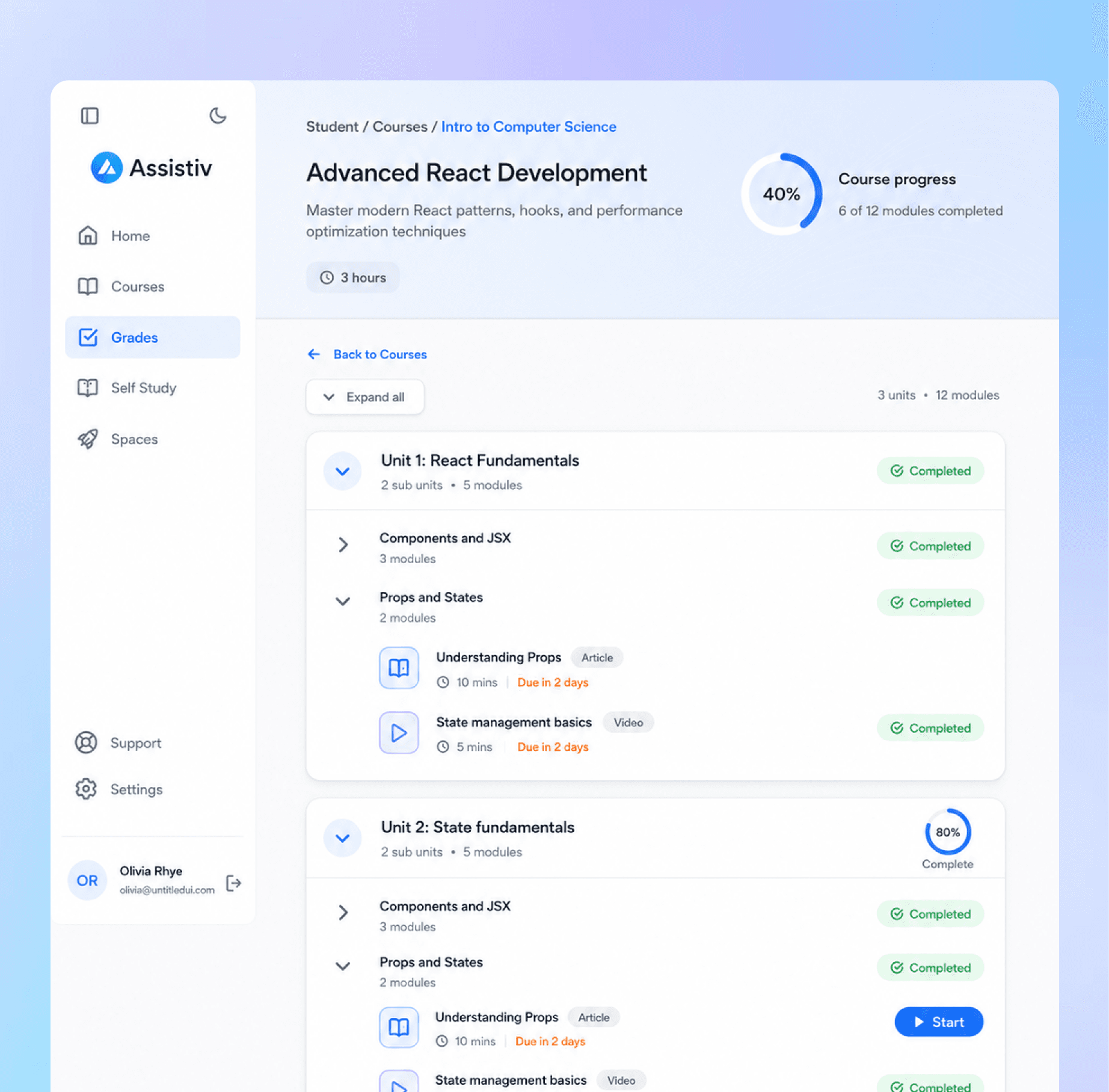
Admins start from the institutions, instructors from courses, and learners from assigned work.
Risk is visible before a query
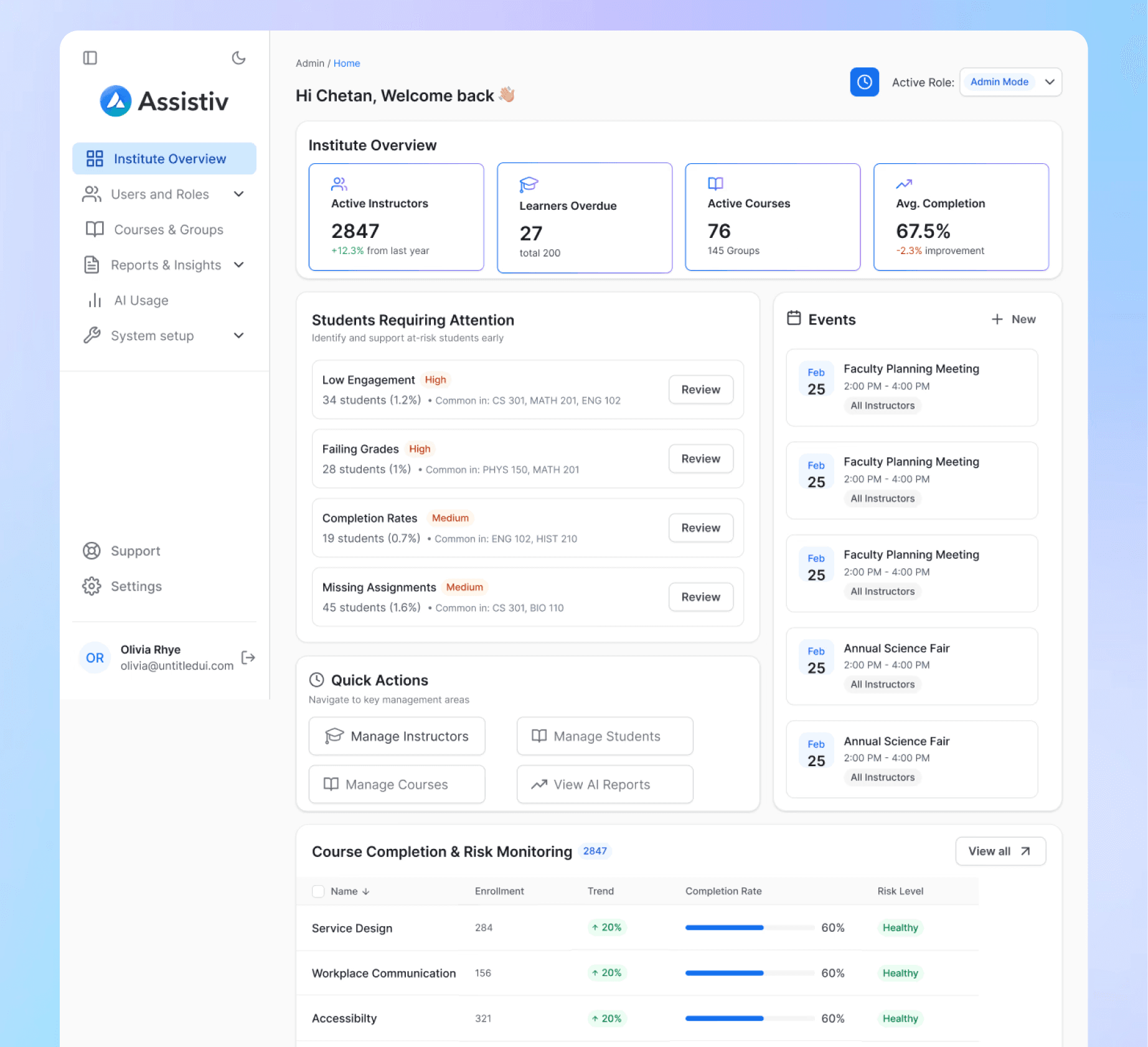
The admin homepage loads at-risk cohorts on load and carries that context into the next action.
New features reuse the same rules
Custom roles, messages, AI signals, and onboarding all use the same permission and audit model.
Intervention
I replaced the report-first homepage with a ranked worklist.
Outcomes & Lessons
My contribution, and what I learned
0
Steps before risk is visible
Previously: four filters and a manual row scan. Now: ranked on page load.
Path from signal to action
Risk → cohort → learner → reminder, without rebuilding context.
1 path
Custom roles use the existing model
Non-standard teams can be configured without adding another navigation system.
Flexible
Actions are written to history
Every learner-facing intervention includes the actor and timestamp.
Auditable
Platform context during the same period
These numbers show the size of the environment. They are not presented as direct design impact.
20 -> 100+
Enterprise clients
2,847
Active Instructors
67.5%
Average learner completion
How I led
Aligned the founder on role separation over a permissions filter, mapped the permission model with backend engineering before designing the UI, sequenced rollout so admin shipped first, ran partner research sessions directly with four client organisations, and reviewed implementation screen by screen with the front-end developer.
What changed in my thinking
I came into this believing that reducing surface area is how you serve non-technical users. Both major decisions here disproved it. Filtering one navigation would have been less surface area and the wrong structure. One-click AI generation was less surface area and unusable. Non-technical users do not need fewer controls. They need controls that do not require them to already know the answer.
What I would test earlier
I designed the populated dashboard before the empty one. Every client experiences the empty state first, and I built it second.
Role separation was validated with admins before instructors. We learned the instructor gap from churn instead of from research, which was avoidable.