Amazon Music
2025
🏆 Designing stronger reasons to return to Amazon Music
A four-person product-design team explored how Amazon Music could turn passive Prime listeners into more engaged users. I led the user interviews and owned the Rewards and Loyalty experience from research synthesis through final prototype.
Role
Product Design, Design Innovation, Prototyping
Timeline
4 Week
Team
Me and 3 Designers
Platform
Figma, Adobe Premiere
Role
Product Design, Design Innovation, Prototyping
Timeline
4 Week
Team
Me and 3 Designers
Platform
Figma, Adobe Premiere
Overview
Amazon Music
Many participants used Amazon Music because it was included with Prime, not because they felt attached to the product. Our challenge was to create stronger reasons to choose the service and return over time actively.
I led all 20 user interviews and helped turn the research into two product directions. I then owned the Rewards and Loyalty direction end-to-end, including the reward structure, user journey, dashboard experience, redemption flow, and high-fidelity prototype. I also contributed to the research and ideation behind Suggestion Modes.
Research
Process for the solution
The team collected more than 50 survey responses, while I led the qualitative research. I wrote the discussion guide, recruited participants, and moderated all 20 interviews.
I focused the conversations on listening habits, switching behaviour, recommendation trust, and what, if anything, made users return to a music platform. I then worked with the team to synthesize the findings into four recurring needs.
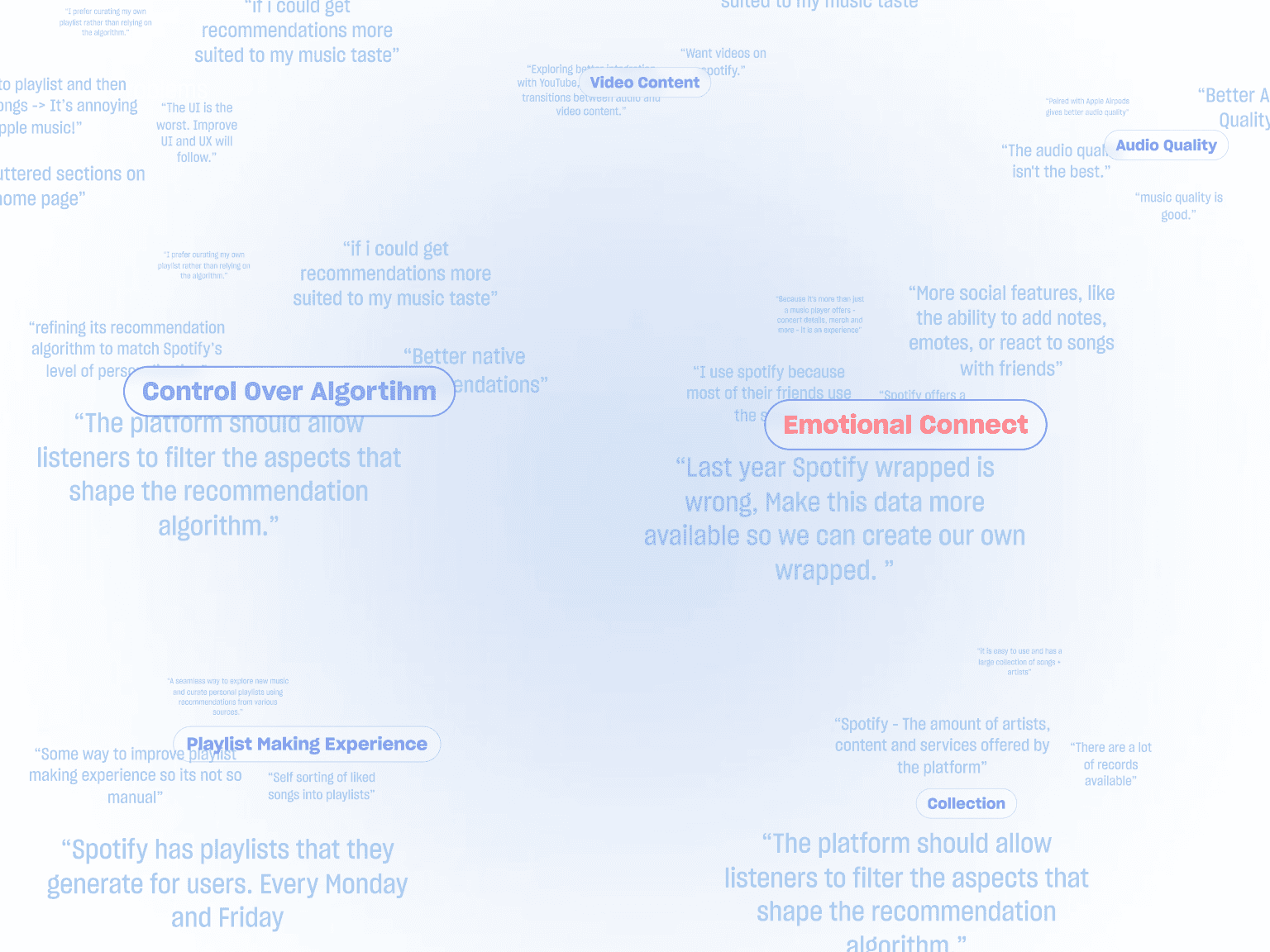
Affinity mapping session, synthesizing survey responses and interviews into clusters. Four core themes emerged.
User Research
What 60 users told us
No control over recommendation
If I could get recommendations that matched my taste, I'd use it way more. Right now, I'm guessing and getting it wrong.
01
“
“
No feedback or recognition
I have no idea if the app is even learning from what I skip. There's no signal at all.
02
Music isn't tied to identity
I want more social features, like the ability to express my emotions and react to songs. Music is personal, but I cannot share it.
03
“
No reason to return daily
I open Spotify when I want music. I only open Amazon Music when I remember it exists
04
“
Ideation
We explored four directions before committing to two
Before narrowing on our final solution, we explored a range of feature concepts, each aimed at a different facet of retention, emotional engagement, and brand loyalty.
Musical Journey
A reflective space where listeners attach notes, moods, or memories to songs. Conceptually strong, but less likely to drive frequently repeat engagement
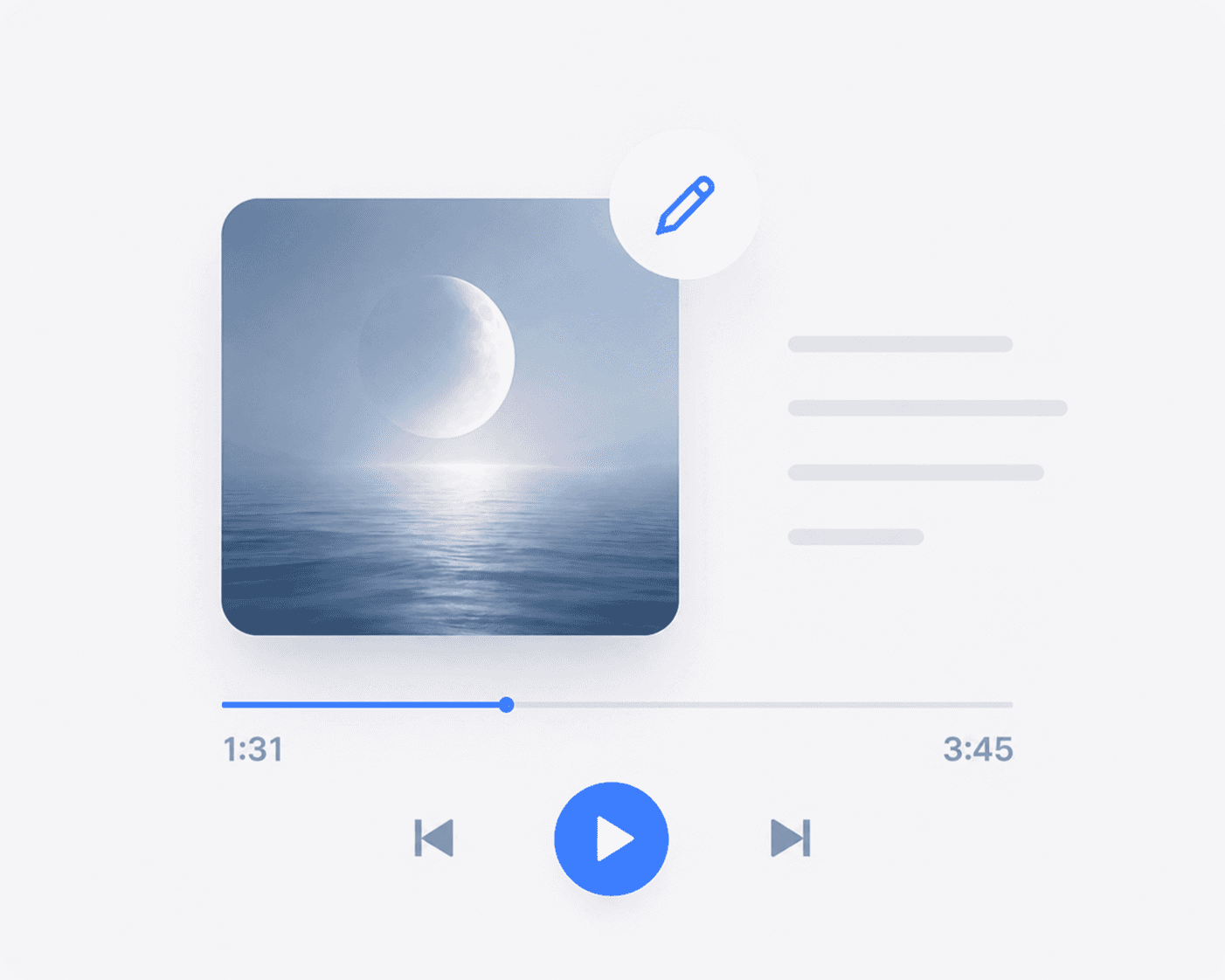
Mood Concept
Playlists generated around mood or activity, Promising, but dependent on inference and context signals that were harder to validate withing scope

Suggestion Mode
A direct way for users to shape recommendations by intent, such as familiar, discovery, vibe or trends. This addressed the clearest user pain point

Rewards & Loyalty
A listening points system tied to Amazon's broader ecosystem. It created a distinct retention loop through perks, credits and loyalty rewards.

We narrowed to Suggestion Modes and Rewards & Loyalty because they best balanced user value, strategic differentiation, and business impact.
Suggestion Mode
Discoverability of control matters as much as the control itself
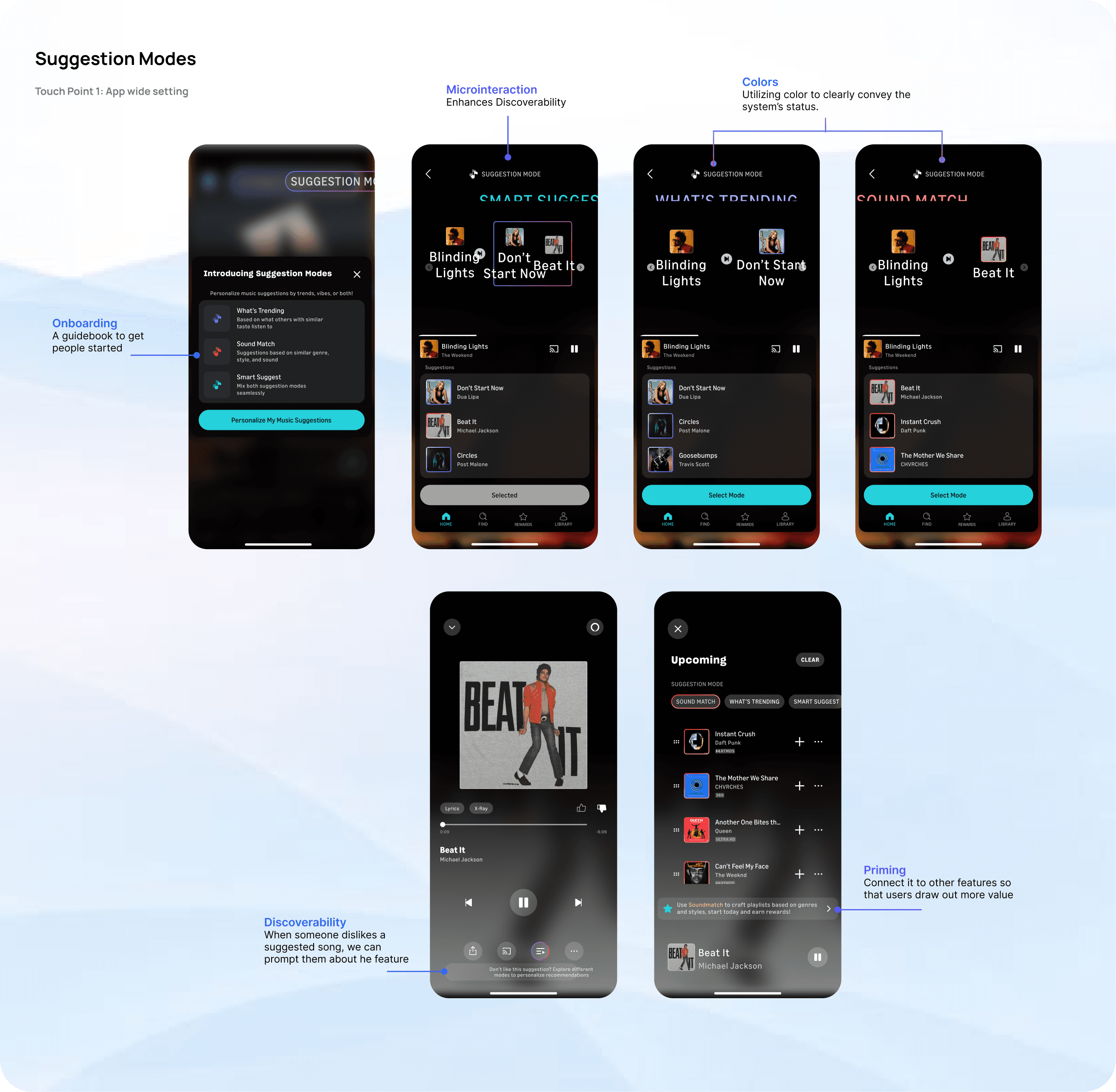
Our research showed that users were frustrated by recommendations they could not understand or influence. Suggestion Modes gave them a simple way to choose the kind of listening experience they wanted, such as familiar music, discovery, trends, or a specific vibe. I contributed the research insights and early ideation behind this direction. During usability testing, the team learned that placing the selector in Settings made the feature nearly invisible. We moved it into the active listening flow and created three contextual entry points.
What's Trending
What people with similar taste are loving right now.
Sound Match
More like the music you already love.
Smart Suggest
The best of both worlds, trending and personalized.

The two recommendation mechanisms behind the modes, collaborative filtering powers What's trending, and content-based filtering powers Sound Match
We almost put the mode selector inside Settings. Usability testing is what caught it.
Nobody opens Settings. That single finding- not a visual preference, a usability-testing result, is what drove us to design three separate touch-points instead of one buried menu. Control only matters if users can actually find it in the moment they need it.
01
Always available on Home
Access Suggestion Mode in one tap, no need to open a menu.
02
Switch modes in Up Next
Change the recommendation mode while browsing upcoming songs
03
Adjust after a missed suggestion
After skipping a song, quickly choose a mode that fits better.
Designs
What we designed
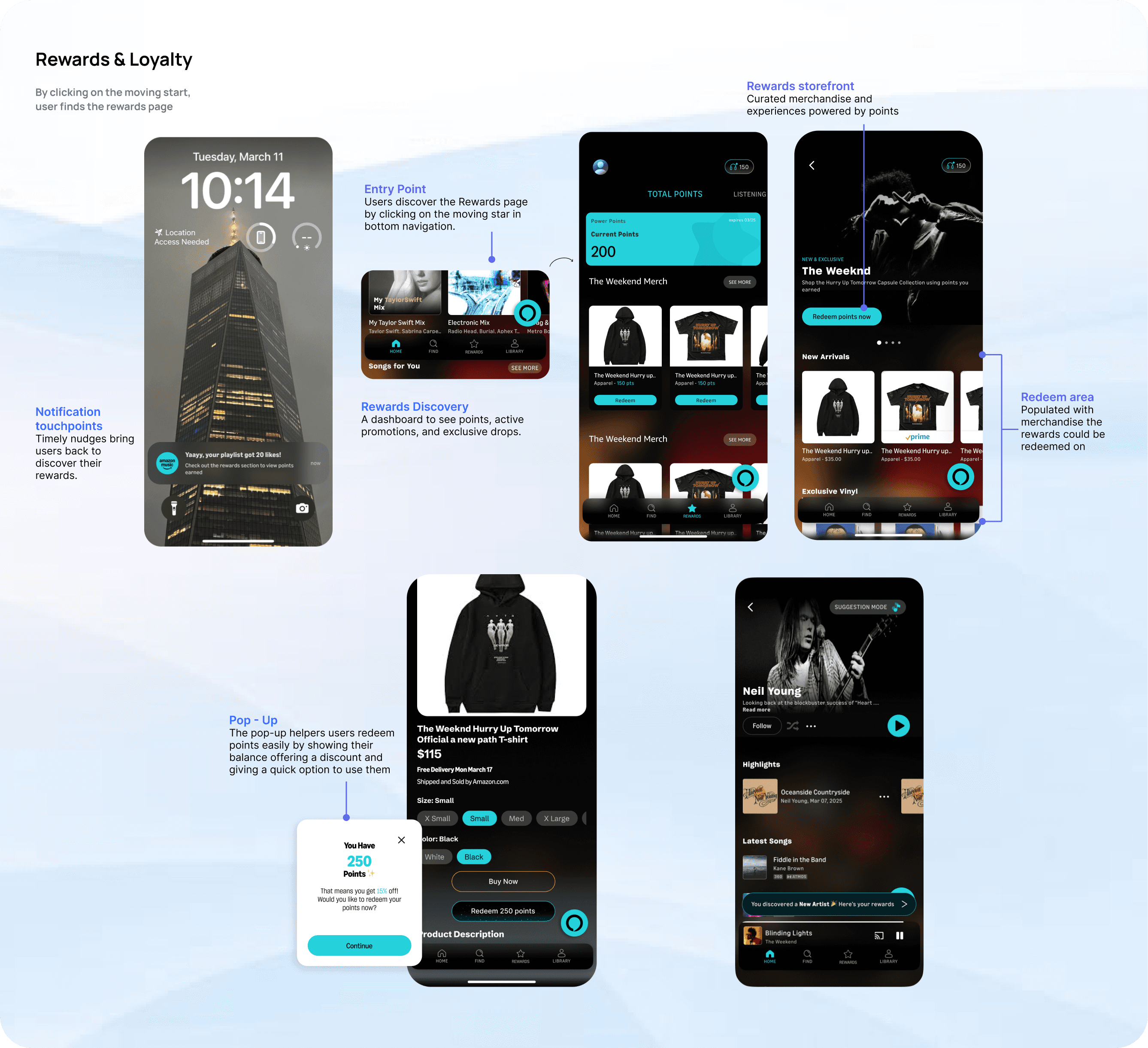
Suggestion Mode and Rewards & Loyalty, both shown here as they'd appear together in the app, not as a toggle between two separate flows.
Business Impact
How the concepts could support Amazon Music’s business
Here's the commercial case for these two systems, followed by what usability testing actually showed versus what we expect but haven't measured.
01
Daily active use
Rewards give users a clear reason to come back, instead of relying on them to remember Amazon Music exists one of the biggest gaps we found in research.
02
Social sharing & virality
Referral rewards and community challenges can encourage people to share the experience naturally, helping Amazon Music grow through its users rather than paid acquisition alone.
03
A psychological effect on users
Suggestion Mode helps users feel like the recommendations are being shaped around their preferences, rather than simply accepting whatever the algorithm gives them.
04
Increases retention & customer lifetime value
A tiered rewards system could drive repeat use and create more opportunities to convert users to Amazon Music Unlimited.
What our research and testing validated
We first placed the Suggestion Mode selector inside Settings, but usability testing showed that people simply did not notice it there. That finding led us to move it into the active listening experience, where users could access it at the moment it was most relevant.
Distrust in the recommendation algorithm also came up consistently across all 20 interviews. It was not a problem we assumed beforehand; it was the clearest frustration users raised themselves.
What we would still need to validate
We expect the rewards loop to give users a stronger reason to return regularly. We also believe that people who engage with Suggestion Mode or Rewards may be more likely to upgrade to Amazon Music Unlimited.
Another hypothesis is that users who actively adjust their recommendation mode will retain better than those who never interact with it, because they feel more ownership over their listening experience.
Success metrics, if this shipped
We would compare 30-day retention between users who change modes and those who do not. We would also track Unlimited conversion before and after launch, reward redemption rates, and discovery behaviours such as listening to new artists or completing playlists.
These discovery behaviours would be useful early signals, since changes in long-term retention would take more time to appear.
Outcome
Recognized for product thinking and design detail
Fine-Tuned Award
Selected from 50+ competing teams
Amazon Music's executive team selected our submission as the winning solution. Looking back at what set our approach apart:
We treated algorithm distrust as the root cause of passive listening, not just a symptom of bad UI most competing teams addressed the symptom.
01
Suggestion Modes gave users a form of control no other streaming platform currently offers.
02
The Reward System leveraged Amazon's e-commerce infrastructure in a way no competitor could replicate.
03
I learned to translate research into product direction
Conducting the interviews was only the first step. The harder work was deciding which patterns represented meaningful product opportunities and which were simply feature requests.
I would bring business context into research earlier
We developed parts of the business case after the concepts were already taking shape. In a future project, I would investigate ecosystem constraints, membership structures, and commercial goals alongside user behaviour from the beginning.
I learned to design the system, not only the screen
Owning Rewards pushed me beyond interface design. I had to think through earning logic, progress visibility, redemption, perceived value and how the system connected to Amazon’s broader ecosystem.

